
When to Replace Commercial Landscaping
Every commercial landscape reaches a crossroads. After years of faithful service, the trees that once provided welcoming shade have grown leggy and overgrown. The irrigation system requires increasingly frequent repairs. The shrub beds that looked contemporary when installed now feel dated against neighboring properties that have modernized their curb appeal. For property managers, facility directors, and HOA boards, the question becomes unavoidable: should we continue investing in maintenance, or is it time for a comprehensive renovation?
This decision carries significant financial implications. Continue maintenance too long on a declining landscape, and you’re essentially paying premium prices to prop up a depreciating asset. Renovate too hastily, and you may invest capital in changes that proper maintenance could have addressed. Understanding where your property falls on this spectrum—and having a framework to evaluate your options—is essential for making sound decisions about your landscape investment.
Recognizing When Maintenance Alone Can No Longer Sustain Your Landscape
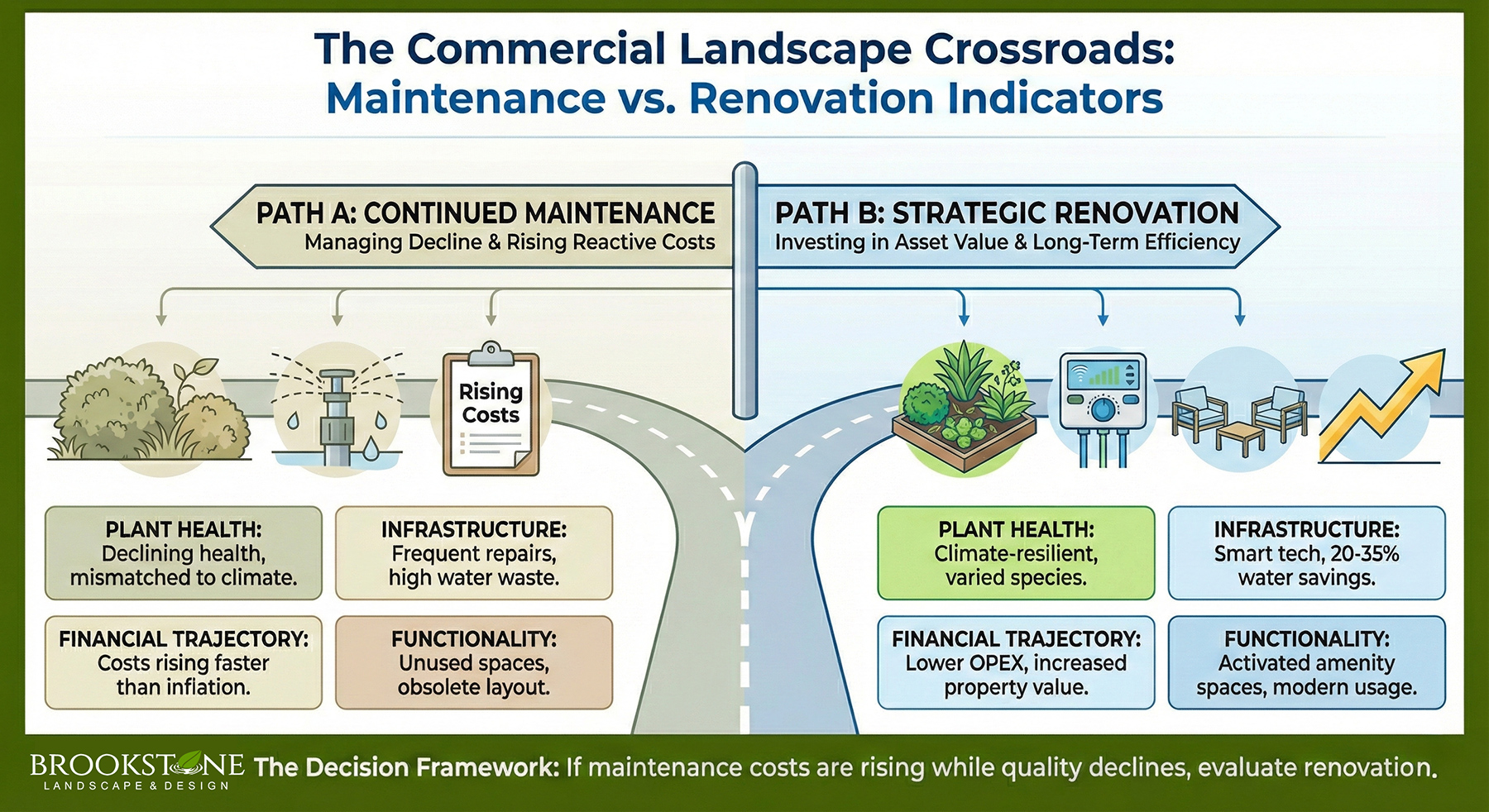
The clearest indicator that renovation has become necessary is declining plant health despite consistent, proper care. When your maintenance provider is doing everything right—appropriate irrigation scheduling, correct pruning techniques, proper fertilization timing—yet plants continue to struggle, the problem typically lies deeper than what maintenance can address. This pattern often emerges in landscapes where the original plant selection was poorly matched to site conditions, where soil composition has degraded over decades, or where changes to the surrounding environment have altered growing conditions beyond the existing plant palette’s capacity to accommodate.
In the Pacific Northwest, this frequently manifests in landscapes installed during the 1990s and early 2000s, when plant selection trends favored species that we now understand are poorly suited to our maritime climate’s unique challenges. Plants chosen for their appearance in nursery conditions often struggle in our clay-heavy soils, prolonged winter moisture, or the increasingly severe summer drought stress that has intensified over the past two decades. No amount of maintenance excellence can overcome fundamental mismatches between plants and their growing environment.
Chronic infrastructure problems represent another decisive signal. Irrigation systems have a functional lifespan of fifteen to twenty years, though individual components fail at varying rates. When repairs become a monthly occurrence rather than an occasional necessity, when water pressure inconsistencies create perpetual dry spots and saturated areas despite repeated adjustments, or when the system lacks the zone flexibility to accommodate different plant water needs, you’ve moved beyond maintenance territory. Similarly, drainage problems that cause persistent ponding, erosion along walkways, or water intrusion toward building foundations rarely respond to maintenance solutions—they require re-engineering.
The economics of your maintenance spending offer perhaps the most objective measure. Track your landscape maintenance costs over three to five years, adjusting for inflation and any service changes. If costs are climbing faster than inflation while landscape quality is declining or merely holding steady, you’re experiencing diminishing returns. Properties in this position often spend maintenance dollars to manage problems rather than to enhance the landscape—essentially paying for damage control rather than asset improvement.
Functional obsolescence presents a different but equally compelling case for renovation. Commercial landscapes serve purposes beyond aesthetics: they direct foot traffic, provide gathering spaces, create separation between uses, and contribute to the property’s marketability. When a landscape no longer serves these functions effectively—when desire paths cut across planting beds because the original circulation design doesn’t match how people actually use the space, when outdoor seating areas sit empty because they lack shade or wind protection, when the landscape’s appearance actively detracts from tenant recruitment or customer attraction—maintenance cannot solve what is fundamentally a design problem.
Evaluating the Return on Investment: Renovation Versus Continued Maintenance
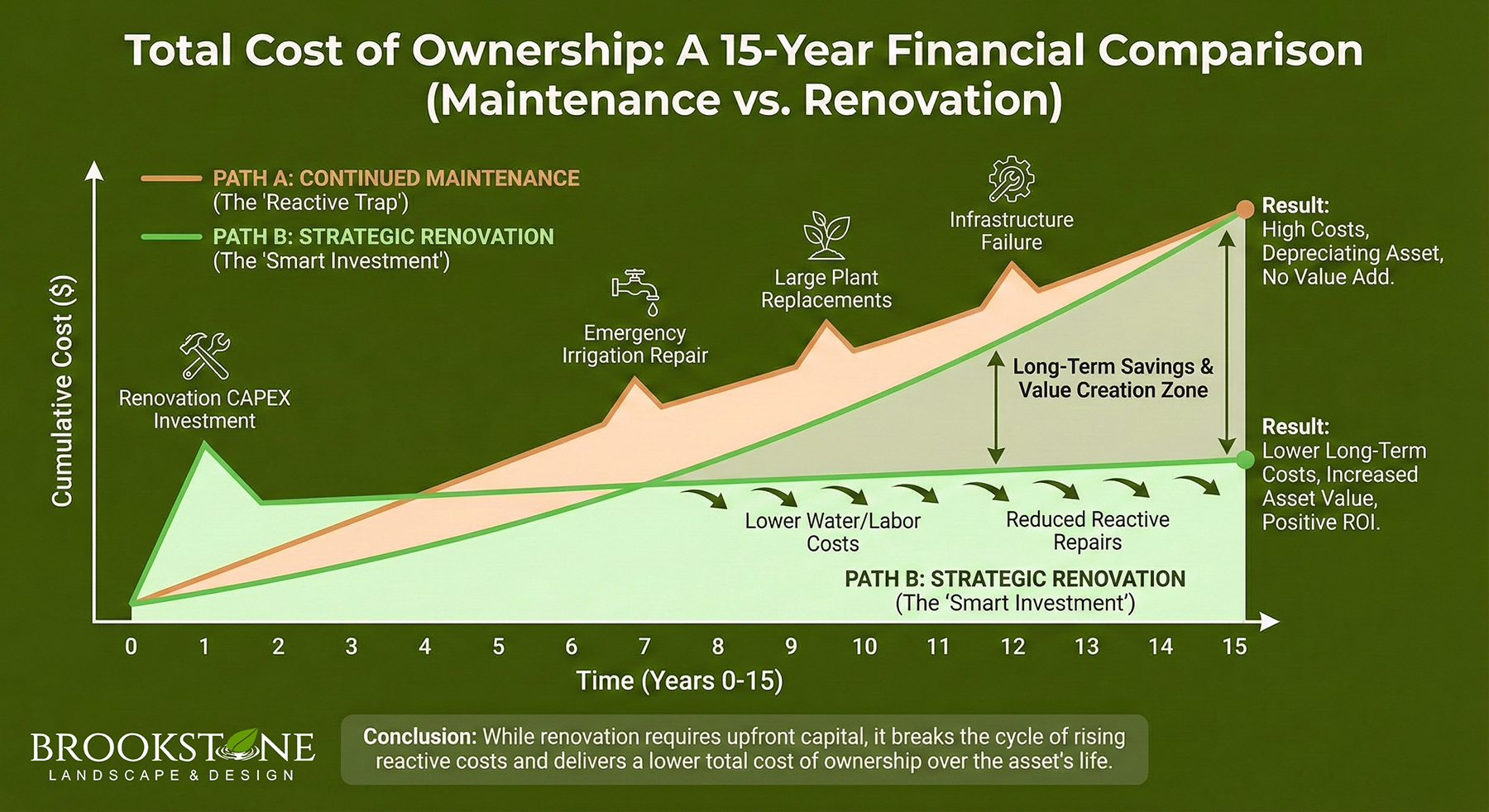
Calculating the true ROI of landscape renovation requires looking beyond the immediate capital expenditure to consider the complete financial picture over a meaningful time horizon. Most commercial landscape renovations should be evaluated on a ten to fifteen-year basis, allowing adequate time for the investment to mature and generate returns.
Begin by establishing your current baseline costs. This includes not only your contracted maintenance fees but also the costs you may not be tracking systematically: emergency repairs, irrigation system fixes, plant replacements, seasonal color that’s being used to mask underlying problems, and any staff time devoted to coordinating landscape issues. For many properties, these hidden costs add thirty to fifty percent to the contracted maintenance figure.
Project these costs forward under a “continue as-is” scenario. If your maintenance costs have been rising at eight percent annually while delivering declining results, assume that trajectory continues. Factor in major infrastructure replacements—irrigation systems, tree removals, hardscape repairs. Many properties discover that their five-year “maintenance” projection actually includes substantial capital expenditures disguised as ongoing care.
Against this baseline, evaluate the renovation investment. A comprehensive commercial landscape renovation typically costs between eight and fifteen dollars per square foot for softscape areas, with hardscape elements, irrigation infrastructure, and specialty features adding to this base figure. However, the more relevant metric is the total cost of ownership over your evaluation period. Well-designed renovations using appropriate plant selections and modern irrigation technology routinely reduce ongoing maintenance costs by twenty to thirty-five percent compared to aging landscapes requiring intensive care.
Beyond direct cost comparisons, quantify the revenue implications where possible. For retail centers, multiple studies have demonstrated that quality landscaping increases customer dwell time and spending. For office properties, landscape quality directly impacts tenant attraction and retention—a factor that translates to real dollars when a Class A property loses tenants to a competitor with more appealing grounds. For HOA communities, landscape condition correlates strongly with property values and the association’s ability to maintain assessment stability.
The most accurate ROI calculations also account for risk mitigation. Aging irrigation systems don’t just cost money in repairs—they create liability exposure when failures cause flooding or slip-and-fall hazards. Declining trees pose increasing risk of limb failure or complete structural failure. Deteriorating landscapes accelerate property depreciation while renovated landscapes typically add to property value. These factors rarely appear in simple cost comparisons but represent real financial exposure.
Phased Renovation: Transforming Properties That Cannot Close
One of the most significant barriers to commercial landscape renovation is operational disruption. Retail centers cannot block customer access to storefronts. Office campuses cannot eliminate parking or obstruct building entries. HOA communities cannot ask residents to avoid common areas for months while construction proceeds. The perception that renovation requires a complete property shutdown prevents many managers from pursuing projects that would deliver substantial long-term benefits.
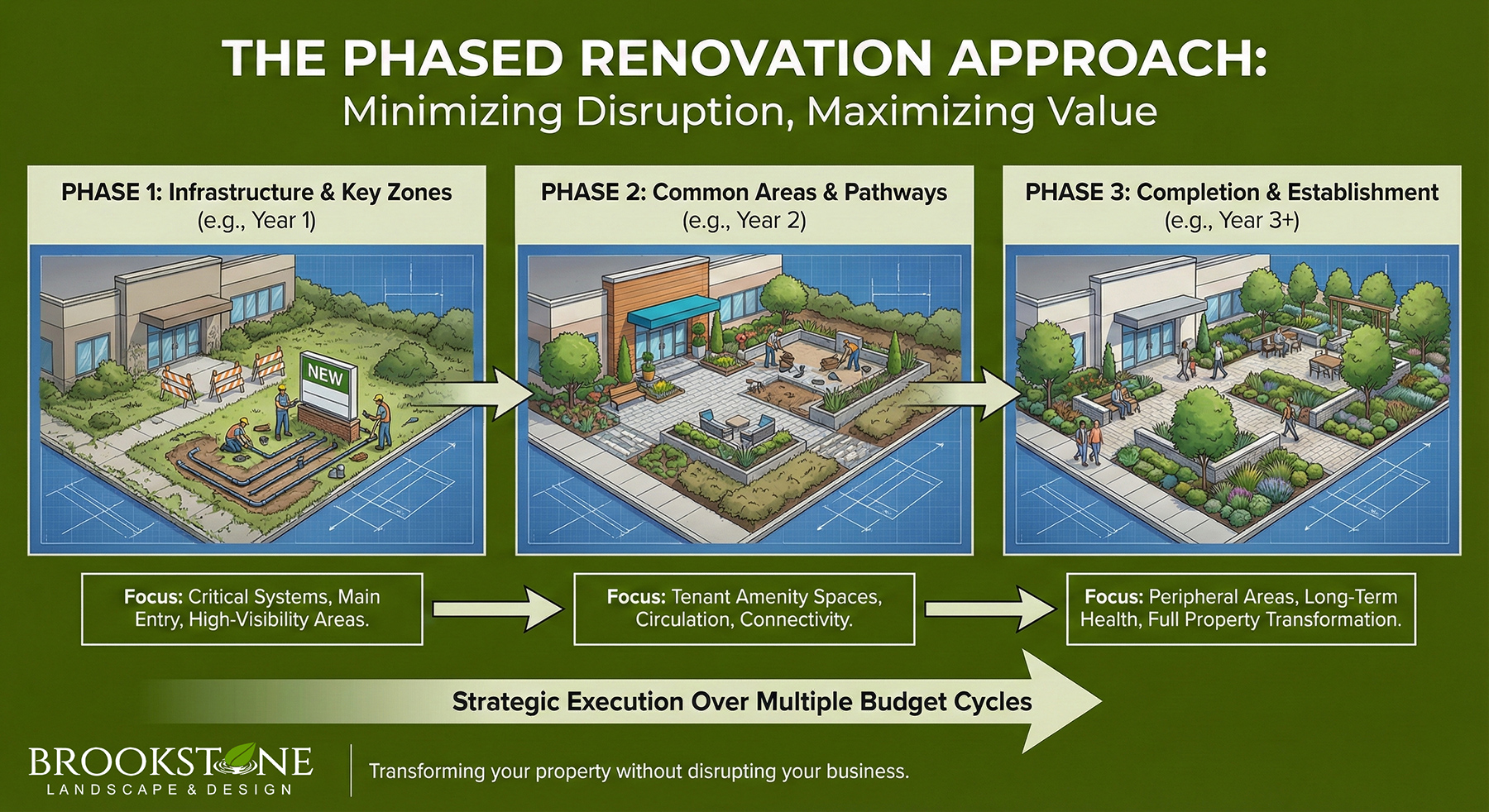
Phased renovation addresses this challenge by breaking the comprehensive transformation into sequential stages that maintain the property’s function throughout the process. This approach requires more sophisticated planning and project management than a single comprehensive project, but it makes renovation feasible for properties where business continuity is non-negotiable.
Effective phasing begins with strategic prioritization. Infrastructure work that affects the entire property—irrigation main lines, primary drainage systems, electrical service for lighting—should typically occur first, as it lays the foundation for everything that follows. Sequencing this infrastructure phase during the property’s lowest-activity period minimizes disruption impact.
Subsequent phases address distinct zones of the property in sequence. For a retail center, this might mean renovating the primary entrance and main drive one season, then progressing to secondary parking areas the following season, then addressing peripheral areas and service zones in the third phase. Each phase delivers visible improvement while construction activity shifts away from the completed areas.
The timeline for phased renovation varies considerably based on project scope and property constraints. Simple renovation projects might be completed in two phases over 12 to 18 months. Comprehensive transformations of large properties may span three to five years, with each phase designed as a functional increment that improves the property, even if subsequent phases are delayed.
Budget implications of phased approaches deserve careful consideration. Phasing typically adds 10 to 15 percent to the total project cost compared to completing all work simultaneously, reflecting the mobilization and demobilization costs of multiple construction phases and the need for temporary measures to tie new work to areas not yet renovated. However, phasing also distributes capital requirements in various budget years, which often makes projects feasible that would be impossible as a single-year expenditure.
Budgeting and Planning for Commercial Landscape Renovation
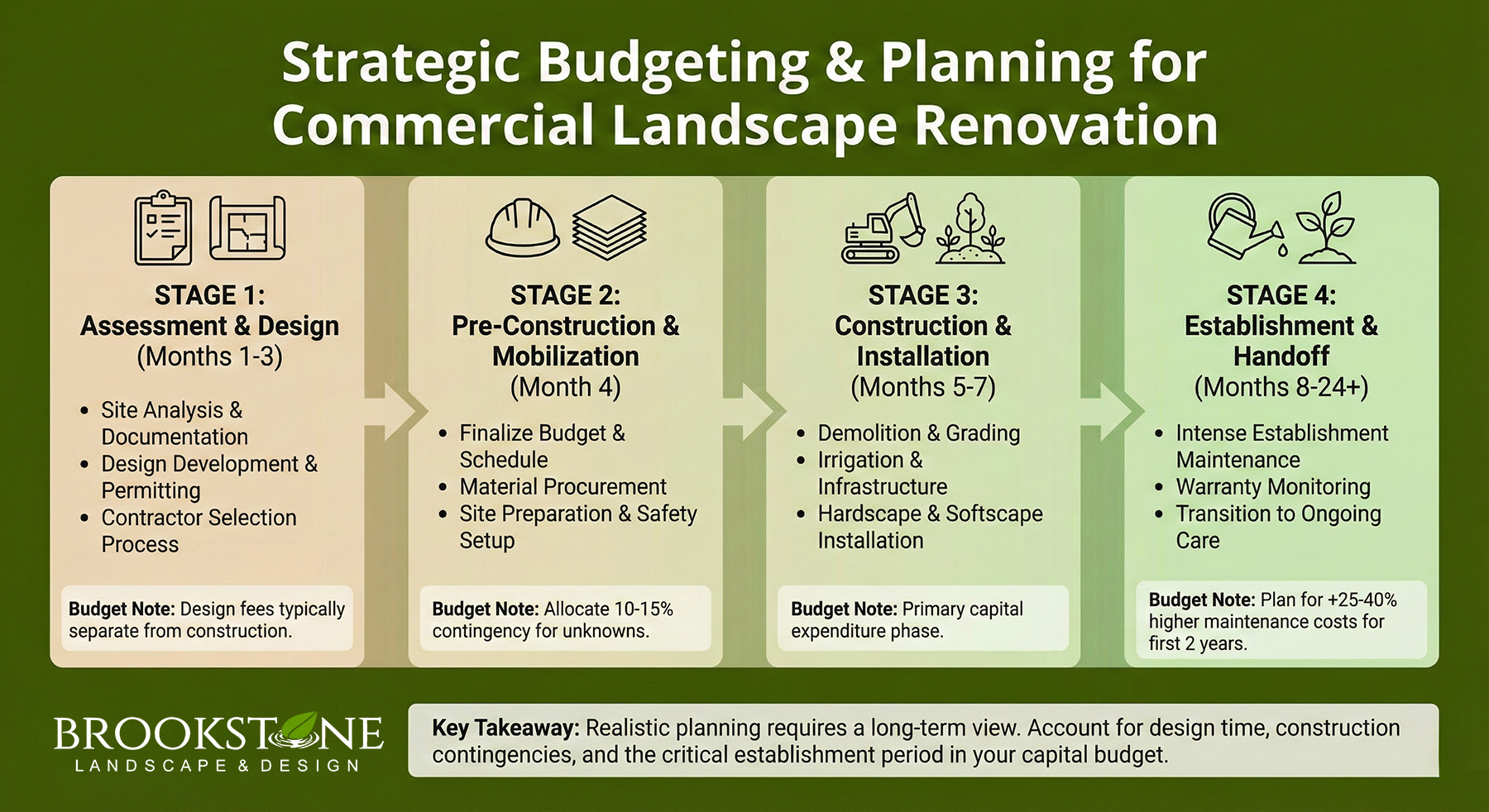
Realistic budgeting begins with a comprehensive site assessment that documents existing conditions and identifies all elements requiring attention. This assessment should go beyond the obvious cosmetic issues to evaluate infrastructure that isn’t visible: irrigation system age and condition, drainage performance, soil health, tree structural integrity, and hardscape condition, including both surface appearance and substrate stability.
For planning purposes, commercial landscape renovation costs in the Pacific Northwest typically range from twelve to twenty dollars per square foot for comprehensive soft-landscape renovation, including plant material, soil amendment, irrigation, and finish grading. Projects requiring significant hardscape work, retaining structures, water features, or specialty amenities will exceed this range, sometimes substantially. Costs also vary with site access constraints, soil conditions, and the complexity of work required while maintaining property operations.
The planning timeline for commercial landscape renovation extends longer than many property managers initially expect. Allow three to six months for design development, permitting, and contractor selection before construction begins. Projects requiring significant grading, structural elements, or work near sensitive environmental features may require additional permitting time. Construction timelines vary widely based on project scope, but property managers should generally plan for primary construction phases of 2 to 4 months, followed by an establishment period of 12 to 18 months during which new plantings require closer attention.
Capital planning should account for establishment-period costs, which often surprise property managers accustomed to mature landscape maintenance budgets. New plantings require more frequent irrigation, more attentive monitoring, and more responsive intervention than established landscapes. Budget for enhanced maintenance during the first two growing seasons following installation, with costs typically running twenty-five to forty percent above what the renovated landscape will require once established.
Contingency allowances are essential for any commercial landscape project. Underground conditions are never fully knowable until construction begins—unexpected utilities, soil contamination, drainage issues, or structural problems regularly emerge during renovation work. Industry-standard contingencies of 10 to 15 percent are appropriate for well-documented sites; properties with limited existing documentation or complex histories may warrant higher reserves.
Evaluating Contractor Capabilities: Maintenance Providers Versus Design-Build Specialists
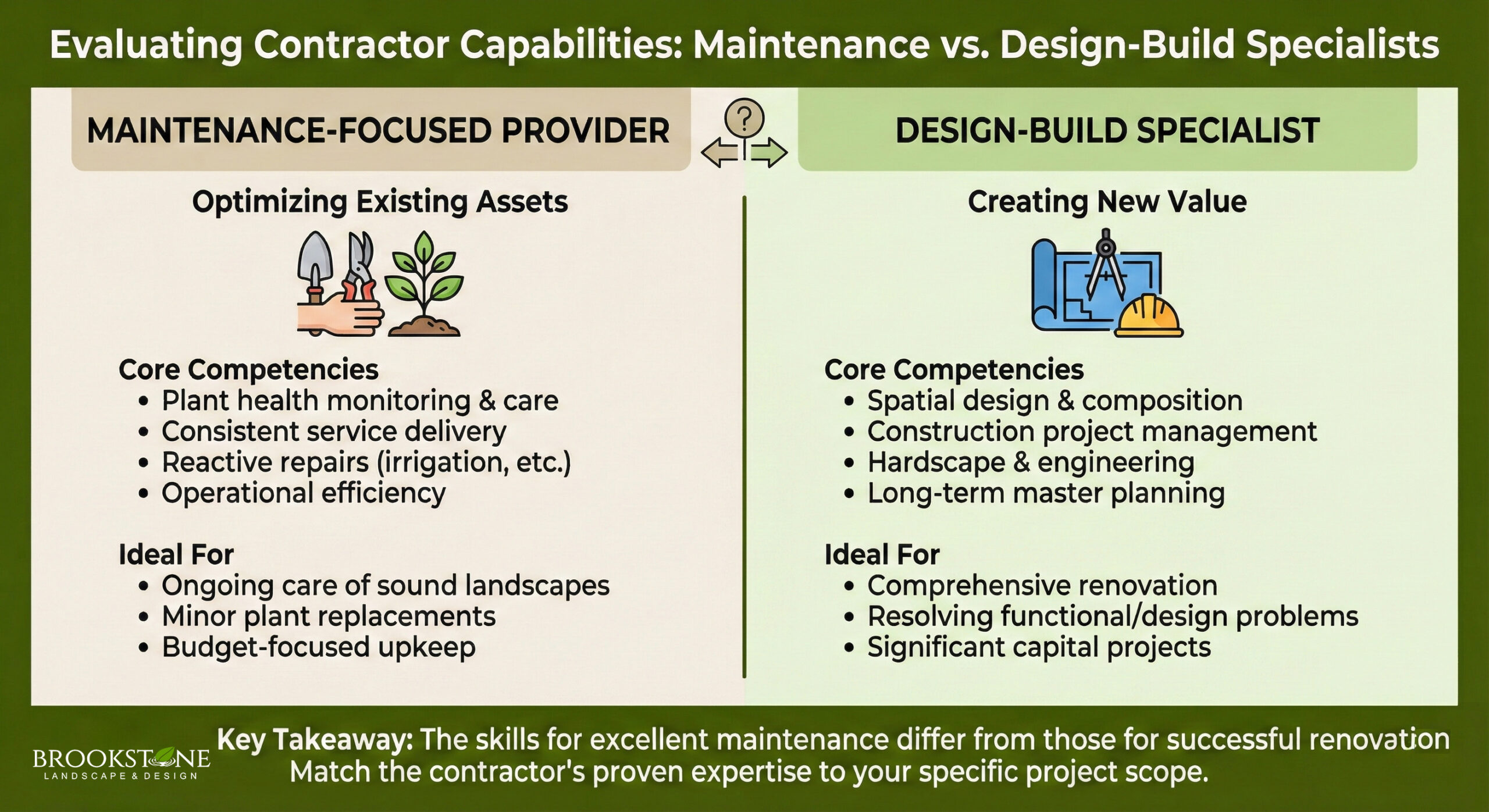
Not all landscape contractors offer the same capabilities, and the skills required for excellent maintenance work differ substantially from those required for successful design-build projects. Understanding these differences helps property managers assemble the right team for their specific situation.
Landscape maintenance-focused contractors excel at optimizing the health and appearance of existing landscapes. Their expertise lies in understanding plant care requirements, identifying and addressing problems early, and delivering consistent, efficient service. These skills are valuable and difficult to develop—quality maintenance requires substantial knowledge and attention. However, maintenance expertise does not automatically translate to renovation capability.
Design-build work requires a different skill set and organizational structure. Effective landscape design demands understanding of spatial composition, plant communities, and long-term growth habits, hardscape engineering, grading, and drainage, and how all these elements integrate to serve the property’s function and aesthetics. Landscape construction capability requires equipment resources, crew depth for larger projects, and project management systems that most maintenance-focused operations don’t maintain.
When evaluating whether your current maintenance contractor can handle renovation work, several questions merit direct conversation. Ask about their design process: who develops the designs, what are their qualifications, and how do they approach translating property needs into design solutions? Request examples of completed design-build projects of similar scope to what you’re considering, and speak with those property managers about their experience. Inquire about construction crew resources: will your project be completed by the contractor’s own crews or subcontracted? If subcontracted, what role does the primary contractor play in quality control and project management?
For significant renovation projects, many property managers benefit from separating design services from construction. Engaging an independent landscape architect to develop the design creates plans that can be competitively bid among qualified contractors, often yielding better pricing than design-build arrangements where the design cost is absorbed into construction markup. Independent design also provides an objective advocate for the property owner’s interests throughout the construction process.
The relationship between your ongoing landscape maintenance provider and any landscape renovation contractor deserves consideration. If you plan to continue with your existing maintenance contractor after renovation, involving them in the landscape design review process ensures they understand the designer’s intent and can maintain the landscape accordingly. If a different contractor will handle the renovation project than your ongoing landscape maintenance, establish clear expectations for warranty responsibilities, hand-off documentation, and ongoing care requirements.
Making the Decision: A Framework for Moving Forward

The renovation-versus-maintenance decision ultimately rests on an honest assessment of three factors: the current landscape’s ability to serve property needs, the economics of continued maintenance versus renovation investment, and your organization’s capacity to undertake a significant capital project.
If your landscape is fundamentally sound, with appropriate plant selections, functional infrastructure, a design that serves current property needs, then quality maintenance remains the suitable path. Even excellent maintenance requires periodic capital investment for plant replacement, irrigation upgrades, and hardscape repairs, but these investments build upon a sound foundation.
If maintenance alone cannot sustain landscape quality, if infrastructure is approaching or past its functional lifespan, or if the landscape design no longer serves your property’s current function and market position, renovation deserves serious consideration. The investment is substantial, but for properties where renovation is genuinely warranted, the returns in reduced ongoing costs, enhanced property value, and improved tenant or customer experience typically justify the capital requirement.
Whatever path you choose, the decision should rest on comprehensive information about your property’s current condition, a clear understanding of your options, and realistic projections of costs and outcomes. The landscape is a significant property asset—managing it well requires the same analytical rigor you would apply to any major capital decision.
Brookstone Landscape & Design provides comprehensive landscape maintenance, design, and construction services to commercial properties throughout Snohomish, Pierce, and King Counties. Whether your property needs enhanced maintenance to reach its potential or complete renovation to serve its next chapter, we bring Pacific Northwest expertise to every project. Contact us to discuss your property’s specific situation and explore the options that make sense for your goals.

